
The new ISO 9001:2026 updates are out, and we’ve all had a bit of time to digest what they mean.
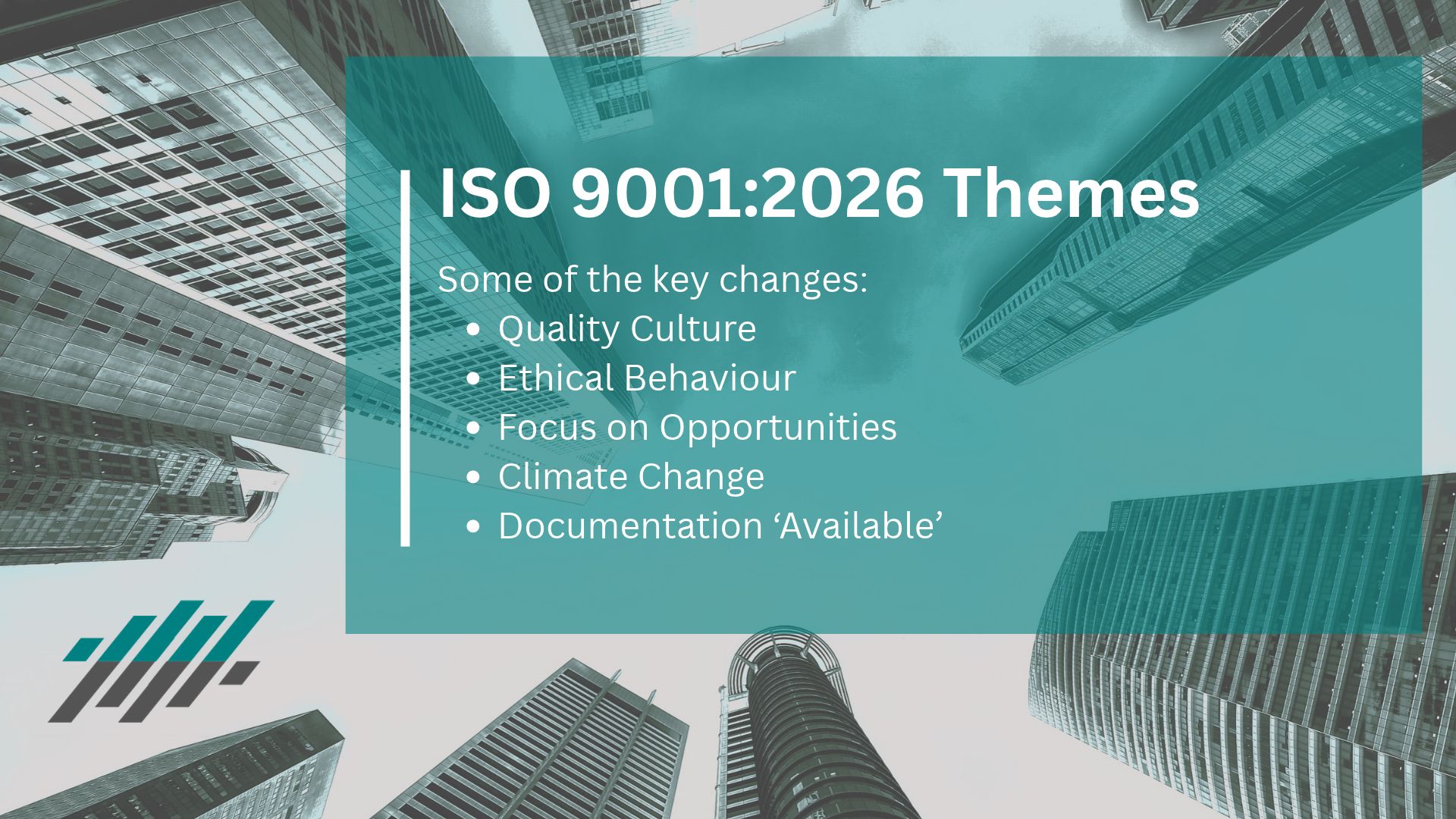
Here’s some of the key themes we noticed, and may be useful for you to understand, in the updated ISO 9001:2026 standard.
A ‘Quality’ Culture
The new standard references the importance of instilling a ‘quality culture’ in multiple clauses – for instance, under the existing Clause 5.1, top management are now likely to be quizzed by an auditor on how they are fostering and taking accountability for a quality culture at the organization.
What is a ‘quality culture?’ Simply, it’s values and attitudes held across the organization which informs day-to-day actions which affect quality. It’s not about ‘hard’ or ‘rigid’ procedures, it is about mindset.
Some organizations will have an easier time fostering this than others. For instance, smaller organizations, where everybody across the chain-of-command sees each other on a regular basis, allows for informal touchpoints where such a culture can be instilled and maintained. This is especially true of small organizations where quality is the key selling point of their product or service, as opposed to, say, volume.
For larger organizations, and especially those more concerned with volume, this will be harder to achieve. After all, this (generally speaking) means an increased detachment between lower-level staff, and top management. One training course on ‘quality culture’ likely won’t suffice – the attendees may take it on and even believe what is taught at the time, but after a few weeks, without regular, short and informal touchpoints, they will creep back into their old mindset and forget the ‘bigger’ picture of quality at the organization.
So, it may take a bit of time, depending on your context, to instil this culture. For those of you who already have a good quality culture, it will be worth considering how to make this quality culture evidencable to an auditor.
Ethical Behaviour
Closely linking to the concept of culture is the instilling of ethical behaviour at the organization.
Ethical behaviour, as many of you will understand, is about going beyond just legal requirements, considering also what is morally correct. It is about the integrity of both individual-, and organization-wide actions.
It is easier than you may think to slip away from honest and fair practices under the pressure to meet deadlines or cut costs. It is also easy to forget about the wider impact of organizational decisions.
Under Clause 5.1, top management, again, will likely be quizzed on how ethical behaviour is instilled and maintained at the organization. Also, under say Clause 4.2, more attention will be given to how your interested parties are treated – namely, those interested parties who are not actually helping you generate money, but perhaps your neighbours or wider community? This all links to ethical behaviour.
Focus on Opportunities
Opportunities were included in the previous standard, but more emphasis has been placed on identifying, acting upon, and reviewing opportunities.
This is encapsulated by the fact that ‘opportunities’ have been split out into their own Clause (6.1.3). This is instead of being combined with risk, as in the previous standard.
Prior to the 2026 version, risk was the main focus of Clause 6.1. Sure, some opportunities would come out of the actions corresponding to these risks, but these were often given a secondary focus.
Now, opportunities should be viewed with a weight equal to risk. Be proactive here; what can you do better at your organization, with regard to quality? Do you have a process in place to systematically identify, evaluate, act upon, and review opportunities such as new technologies, innovative practices, strategic partnerships, or operational initiatives.
Climate Change
Despite this not being the environmental standard, the organization is now encouraged to consider the effect of, and their effect on, climate change when considering organizational context (relating to Clauses 4.1 and 4.2 specifically).
Organizations are now required to determine whether climate change is a relevant issue that affects their quality management strategy and evaluate how interested parties’ requirements may intersect with climate considerations.
It may not be readily apparent to you, but initiatives at your organization may have already covered off this requirement. For example, are you already investing in a fleet of hybrid or electric vehicles? Are you putting in processes already to improve energy efficiency? Or, is your site neighbouring a river, and have you already got flood plans in place?
Once you have identified how you have already considered your effect on, and the effect of, climate change, you can formalise it in your Context Log (if you have one), and / or be ready to explain these initiatives to an auditor.
Documentation Being ‘Available’
A subtle wording change, but one with a significant impact – documentation is now less about simply ‘maintaining’ and / or ‘retaining,’ but documentation being ‘available.’ Under the previous standard, this was actually a requirement too in Clause 7.5, which made it clear that documentation should be readily retrievable.
But, in practice, this requirement of documentation retrievability (or availability) was given a relatively low importance. Now, ISO are looking to clamp down on this, it seems, by making it clear that documentation shall be ‘available.’ Yes, the key word here (and I’ll see it again) is ‘available.’
Having it is one thing – can you pull up the document or record, when asked by the auditor, in good time?
If this is something you are struggling with, it may be a case of reviewing how your documentation is organized or titled, and making sure everyone knows the processes behind documentation within your organization well.
That concludes some of the notable changes. There are more, yes, but these are some key themes that form the bulk of the changes.